Understanding the Alphabet Soup of Therapy
Understanding the alphabet soup of therapy—like IFS, CBT, ACT, and EMDR—can be overwhelming when you are searching for the right clinical support.
I recently wrote a post answering a common question from my practice: which counselling modalities are the most helpful? While therapy is never one-size-fits-all, combining Internal Family Systems with somatic nervous system regulation helps people shift out of reactive habits and build real emotional safety.
Any advice on of what counselling modalities might be the most helpful?
This question was asked from my last blog posting, and below is my answer!
Understanding the Alphabet Soup of Therapy
When you begin looking for a counsellor, it is incredibly easy to feel overwhelmed by the sheer volume of acronyms and technical terms out there. You will see listings of different modalities such as IFS, CBT, ACT, and EMDR, just to name a few.
Counsellors use the term modality to describe a specific therapeutic approach. Modalities are not usually taught as part of a standard counselling psychology master’s program; instead, they more often involve post-graduate trainings. A great number of these trainings are offered by official institutes with structured levels and credential programs. By understanding how different modalities work and learning how to look for them, you can find a therapeutic style that truly resonates with your personal needs.
The Power of Self-Awareness and Internal Family Systems
When working with clients individually, my approach is never one-size-fits-all because it varies depending entirely on what is going on for you in your life right now. With that said, there are specific approaches that I naturally gravitate toward because of how effective they are.
Initially, our work together often involves helping you develop a greater sense of self-awareness. This means learning how to be genuinely curious about what comes up for you emotionally, cognitively, and physically.
One of my preferred modalities is Internal Family Systems, or IFS. This framework explores what shows up for people from the perspective of different "parts" of their personality. When people are struggling, what often comes up first are their protective parts. These protective parts can manifest in many familiar ways, including:
People-pleasing: Constantly putting others first to avoid conflict or rejection.
Perfectionism: Holding yourself to impossible standards to shield yourself from criticism.
Humour: Deflecting deep pain or vulnerability with a quick joke.
Substance or online use: Using alcohol, drugs, gambling, video games, porn, and/or other behaviors to numb difficult emotions.
Shut down: Mentally or emotionally withdrawing when things feel like too much to handle.
From a curious lens—what is called "unblending" in IFS—we explore the functionality of these parts. We look at what they are ultimately trying to protect you from, which is often deeply rooted pain, shame, feelings of unworthiness, or mistrust, known as exiled parts of the self.
Moving From Reactivity to Self-Energy
An important step forward in therapy happens when a client is able to unblend from these protective parts. Often, clients completely self-identify with their protectors. They will describe themselves by saying, "I’m a perfectionist," "I’m an anxious person," or "I’m just not an emotional person."
The real shift occurs when you realize that you are not your anxiety or your perfectionism. Instead, you are a person who developed an anxious or perfectionist part—usually in childhood—as a way of coping with or surviving something traumatic, difficult, or socially unacceptable.
Recognizing the protective nature of these parts is an incredible part of the healing process. Strengthening your capacity to access what IFS calls "Self-energy" is the core of this work. Self-energy consists of qualities like curiosity, self-compassion, connectivity, and courage.
When you learn to access Self-energy rather than reactively letting your protective parts drive the bus, you gain the capacity to look deeper into your history. We can then explore how your parts relate to your childhood, your family of origin, and various cultural or societal factors. With a greater capacity to access your core self, you can begin making different choices in your life, fueling a genuine sense of empowerment and self-belief.
Grounding the Work in Your Nervous System
While parts work is incredibly deep and transformative, it is equally important to ground that work directly into the physical body. This is why another highly helpful approach I integrate into my practice is helping clients understand the functionality of their own nervous system.
This process involves developing a real-time awareness around the emotional and physiological feelings of dysregulation. Dysregulation can look like active states of anger, panic, and anxiety, or it can look like passive states of numbing and total shutdown.
Once we recognize these states in the body, we work on developing the capacity to build pathways back into regulation. We do this by using sensory-based somatic tools. Some of the practices we might use include:
Mindful breathing: Using intentional breathwork to signal safety to your brain.
Sensory connection: Grounding yourself in the present moment by focusing on what you can physically hear, feel, or see around you.
Body awareness: Noticing where tension is held and consciously letting it soften.
By pairing nervous system regulation with IFS, you able to not just understand your patterns intellectually, but you are also giving your body the physical safety it needs to regulate and heal.
How to Navigate the Search for a Counsellor
Because there is so much information out there, I always encourage prospective clients to take an active, research-driven role in choosing their therapy framework. You do not have to guess blindly. There are excellent, accessible tools available to help you find the right fit.
I highly recommend utilizing respected counselling directory portals, such as the British Columbia Association of Clinical Counsellors (BCACC) website or Psychology Today. On these directories, counsellors will explicitly list their modality approaches, whether that includes IFS, Acceptance and Commitment Therapy (ACT), Cognitive Behavioural Therapy (CBT), Eye Movement Desensitization and Reprocessing (EMDR), or others.
Use these descriptions as a starting point to do your own online research. When you find someone who seems like a good fit, set up an initial consultation. A consultation is a great opportunity for you to ask direct questions about their modalities. You can ask them why they use those specific tools and how those frameworks might apply to what you are currently going through. I provide this space during my own consultations because it builds a transparent, collaborative relationship right from day one.
Becoming Merchants of Hope
Every person has the capacity to develop a greater sense of self-awareness. It all starts with a simple willingness to be curious about what is showing up inside of you emotionally, cognitively, and physically. If you are feeling stuck, exhausted by perfectionism, or trapped in a state of emotional shutdown, please know that you do not have to be alone in this process.
In the world of Internal Family Systems, practitioners are often referred to as "hope merchants." We trade in the fundamental belief and hope that things can be remarkably different for you. You are entirely capable of healing, and you do not have to carry the weight of your protective and exiled parts all by yourself.
How Can Counselling Save My Relationship?
How can counselling save my relationship is a question I hear a lot from exhausted couples visiting my Vancouver practice. Therapy helps you move past the endless play-by-play arguments by shifting the focus to your underlying emotional needs. It provides a safe space to slow down, break down defensive walls, and learn to truly hear each other again.
When couples come to my Vancouver office on the brink of breaking up, they are usually exhausted. They have been caught in a relentless cycle of arguing, and they often feel like they are speaking two entirely different languages. The question on their minds—whether they say it out loud or not—is often the same: how can counselling save us?
Many people think the goal of couples therapy is to have a referee decide who is right and who is wrong. But real relationship recovery does not happen by rehashing the details of your latest argument. It happens by shifting how you communicate, how you understand your own emotional triggers, and how you show up for each other.
Moving From the 'Play-by-Play' to Real Impact
The most critical shift that happens in a counselling session is moving away from the surface details of a fight and turning toward the underlying emotional impact.
When couples try to resolve issues at home, they often get stuck in a play-by-play recap of the event. This usually shows up as a repetitive cycle of complaining, criticizing, and bringing up historical grievances. One person lists what the other did wrong, and the other immediately gets defensive.
Counselling helps you stop focusing on what happened and start focusing on how it felt. The goal is to transition from criticism to expressing how your partner’s actions impact you emotionally. For a relationship to heal, both partners need to learn to validate, acknowledge, and understand what is happening beneath the surface for the other person. In therapy, we call this attunement. Even if you do not entirely agree with your partner’s perspective, learning to attune to their emotional reality is what transforms a contentious dynamic into a collaborative one.
The Reality of Rebuilding Trust and Connection
Slowing down this defensive, reactive loop takes practice. In a session, my role is often to remind couples to slow down, take a breath, and actively name what their partner is feeling or believing before rushing to defend themselves. This process of mirroring and checking in—simply asking, "did I get that right?"—encourages a pause and begins to rebuild safety in real-time.
Of course, this loop becomes even more complex when there is a long history of betrayal or deeply rooted resentment. In those spaces, trust is incredibly difficult to restore. Rebuilding that foundation takes time, immense patience, and deep dedication. It requires a willingness to endure discomfort and sit with uncertainty. This can be an exhausting emotional journey for couples to navigate, regardless of how much love is still present between them. Love is the starting point, but the endurance to do the heavy emotional lifting is what sustains the healing.
Breaking Through the 'I'm Not Emotional' Barrier
Family and societal conditioning heavily impacts how we show up in relationships. For many men, the hardest hurdle is attunement—understanding their own needs, vulnerabilities, and triggers, as well as their partner's.
Saying "I'm just not an emotional person" is rarely a true personality trait. It is usually a limiting belief born from early conditioning that holds men back from experiencing deep emotional safety and security in their partnerships.
To bridge this gap, I often recommend individual therapy alongside couples work. It provides a private space to unpack personal conditioning, identify triggers, and build emotional availability. Taking responsibility for your own emotional growth is one of the most powerful ways to support the couples counselling process.
A Tool You Can Try Tonight: Reflective Listening
You do not have to wait until you are sitting in my office to begin moving away from play-by-play fighting. You can start practicing a foundational skill tonight at home: reflective listening.
Reflective listening requires you to entirely drop the desire to fix the problem, offer advice, or state your own opinion. Instead, your sole focus is to validate, acknowledge, and understand what is going on emotionally for your partner.
The next time your partner brings up a frustration, resist the urge to defend yourself or counter-argue. Instead, use these framing phrases to check your understanding:
"What I hear you saying is..."
"I can see how you might feel that way, and it makes sense that you'd be upset."
Listen to their response, ask them if you got it right, and allow them to clarify. By simply shifting your focus from defending your position to validating their emotional experience, you begin to soften the defensive walls and open the door to real, lasting connection.
To learn more and book a free consultation click on Couples Counselling
Questions & Answers
For the next couple of months I’m going to be asking and answering questions relating to all things counselling.
Over the next couple of months I’m going to be asking and answering questions relating to all things counselling. You’re welcome to contribute by sending your own questions as well as providing any comments or feedback.
How to Choose the Right Counsellor for You?
Finding the right counsellor can feel daunting, especially when dealing with stress, anxiety, or relationship issues. However, finding the right fit is the most crucial step toward meaningful change. As a counsellor specializing in men's mental health and couples therapy, I see many people start this search with the wrong expectations. Understanding what therapy actually is—and what it isn't—is the key to finding a professional who can truly support you.
Moving Past the "Fixer" Misconception
The most common mistake people make is seeking an expert to fix their problems or give direct advice. It is natural to want a quick solution or a step-by-step blueprint when you are hurting. However, if a professional simply hands you instructions, they are acting as a consultant rather than a counsellor. The right professional will not tell you how to live your life. Instead, they act as a collaborator, helping you build your own internal awareness so you can navigate life's challenges yourself.
Prioritizing the Relational Fit
Counselling is fundamentally relational. The single most important factor in successful therapy is finding someone you feel comfortable and safe opening up to. During a first session, pay attention to whether you feel the counsellor "gets" you. This connection is the foundation of therapy. When this relationship feels secure, you will feel safe enough to process the things you might usually hide, such as deep shame, fear, or uncertainty.
Balancing Tools with Deeper Exploration
A skilled counsellor knows how to hold space for immediate distress while looking at the bigger picture. Look for someone who balances practical, present-day tools with deeper, trauma-informed inner work.
Keep in mind that just wanting to develop tools to better deal with what’s going on in your everyone day life is perfectly fine. Counselling can also offer the opportunity to dip deeper into exploring yourself, and this is only when you feel ready or see the value in doing so at this particular time in your life.
Embracing a Philosophy of Growth
Healing is a journey that takes time. The process is ultimately about developing your own capacity to change how you relate to yourself, becoming:
More curious with yourself instead of judgmental
More forgiving of your past mistakes
More compassionate toward your struggles
More courageous in facing your fears
Your ideal counsellor is a steady guide who can hold space for all of it—your anger, shame, fear, and victories—as you discover your own path forward.
Update 2026
Happy New Year Everyone!
As we move through the start of 2026, I am feeling a deep sense of inspiration and focus. I want to share a few significant milestones from my journey over the last year—both professional and deeply personal.
Professional Milestone: IFS Level 1 Completion
I am proud to announce that I have officially completed my Level 1 Training in Internal Family Systems (IFS). For those unfamiliar, IFS is a transformative, evidence-based model that views the mind as a system of "parts"—different inner voices like the perfectionist, the inner critic, or the one that breaks down under pressure. This training has deeply impacted my practice, providing new ways to help clients lead their internal worlds with curiosity and compassion rather than judgment.
Coming Soon: Men’s IFS Group (Spring 2026)
In the spirit of this new training, I am rolling out a Men's IFS Group within the next three months (launching by April 2026). This group will provide a dedicated space for men to explore their internal systems—uncovering the "protector" parts that often lead to anger, shutdown or isolation and moving toward more authentic Self-leadership.Recent Inspirations: From Mexico to Cortes Island
My recent travels have been a powerful mix of quiet reflection and vibrant celebration:
A Legacy of Zest in Mexico: To honour my mother, who passed away this past March, I joined my siblings and sister in-law for an Nia danceretreat at Mar de Hade in Mexico. My mother, a dedicated Nia dancer, was a true inspiration—her "zest for life" was evident in everything she touched: dance, theatre, music, family, and food. Dancing with my family was the perfect tribute to her vibrant spirit, reminding us all to lead with movement, playfulness, connection and joy.
I really can't say enough of how my new passion for dance has changed my life, providing both a wonderful community and antidote to winter's dreary darkness.
Deepening Practice at Hollyhock: This past summer I also attended (with my sister) a meditation workshop with Jeff Warren at the Hollyhock Retreat Centre on Cortes Island. Immersed in the old-growth forests of BC, we explored "meditation for being human"—blending silence with a deep sense of the inter-relationship of the natural world.
* Feel free to email for more information on the men's group or details on the two wonderful retreat centres I was fortunate to attend last year
Emotional Expansion
Compassion is fuelled by understanding and accepting that we’re all made of strength and struggle—no one is immune to pain or suffering. Compassion is not a practice of ‘better than’ or ‘I can fix you’—it’s a practice based in the beauty and pain of shared humanity…..Brene Brown
Even though I've been out of school for quite a few years, I still think of September as a new beginning, and a time to ponder all the things I put off doing during the summer.
Writing a newsletter would be one of them as well as designing an online communication course and further developing my Facebook Practice Compassion Group.
I should note that getting into a regular stretching practice and eating less ice cream are top of the list too!
This summer, Brene Brown’s Atlas of The Heart really got me thinking about the nuances of emotions, and the quote above (from the book), helped me get even a clearer picture of the intricacies of compassion, and how its an essential part of empathy.
The connection between language and emotion is an important theme of the book, and how our feelings are limited by ability/inability to identify emotions.
For instance, a person might say that they are angry (surface emotion), without really understanding that what resides underneath are feelings of disrespect, helplessness and/or fear. When we can understand the nuances of our feelings (beyond anger, sadness and happiness) the limits of our emotional world are able to expand.
This is exciting for me personally and therapeutically, because the development of emotional vocabulary then becomes a direct window into the ability to express/understand feelings.
For example, if I understand that my sadness is actually about feeling shame, I can then take this insight and learn to be more self-compassionate/empathic, which is a fundamental part of healing.
That’s it for now, and you’re welcome to check out my FaceBook Self-Compassion Practice Group for weekly quotes/ponderings.
Hope everyone is enjoying the last days of summer,
Jason
Safety Always First?
The desire for safety stands against every great and noble enterprise……Tacitus
These wet September days have given me time to reflect and consider the role of my own "safe place.” Safety is very important to us all, and so many peoples' struggles are related to not feeling safe while growing up and experiencing some form of abuse or trauma as adults. In my professional work, helping support clients develop a sense of safety in themselves, their environments, and in other people is a central part of therapy.
Another important part of personal development and healing relates to Tacitus’s declaration, which involves stepping out of one's comfort zone as a way to grow and mature as a person. It's rather paradoxical in that we all want to feel safe, but often in doing so deprive ourselves of those things that we truly desire and need.
An example of this would be someone who suffers from social anxiety. By deciding not to go to a party, event, or gathering, they may feel a sense of safety and comfort. However, in doing so they may suffer by feeling isolated and disconnected. As social creatures, we all want to feel securely attached to others, but sometimes safety and comfort can get in the way of maintaining and cultivating those connections.
Safety may also involve avoiding having those difficult conversations with friends, family members, or partners. This may allow some short-term comfort, but in the bigger picture creates more distancing, resentment, and feelings of aloneness.
Another example would be not taking a professional risk, like quitting your job, asking for a raise, or seeking a promotion, because there's a fear of the unknown. Yes, there's a certain safety in doing so, but the cost could be the loss of a great opportunity or getting the acknowledgement and recognition you deserve.
There’s a great podcast called We Regret to Inform You which discusses how people have experienced tremendous forms of rejection, yet willfully continue to step into the unknown. For instance, actor Mark Ruffalo auditioned for 800 roles before finally getting a break that launched his career.
Stepping out of your comfort zone can take a great amount of courage and, as the podcast reveals, a supportive network of people that rally around you, especially when overwhelming feelings of doubt, fear, and uncertainty arise.
It can start with just one courageous small action, which can develop into finding your voice, connecting with others, and personal evolution!
The Practice of Shinrin-Yoku (Forest Bathing)
Throughout the pandemic one of things that has been a constant in life has been my weekly walks in nature. Today, I even left my phone in the car, and tried to practice what the Japanese refer to as shinrin-yoku, which involves (from my understanding) slowing down, and really connecting with the senses. It’s amazing how much sensory bandwidth opens up when one decides to be intentional, focusing on what is literally right there. The tiniest mushrooms growing out of a recently fallen tree, the sound of a distant river, the smell of whatever nature smells like after a heavy rainfall.
Sure, there was that time when I thought to myself it would be nice to have my phone to capture this spectacular double waterfall, but did my best to just appreciate the now of it all. The challenge at times with being present/engaged is how much our minds are continually pumping out narratives, often revolving around the possibilities. Likewise, when those possibilities have seemingly past, the mind creates new stories of what could/might have been.
Getting caught and lost in these mind-loops can have a hefty impact, causing one to feel frustrated or annoyed, and can provoke stronger emotions like anxiety, anger, distress, even panic.
As an antidote, shinrin-yoku can be likened to the mindful practice of letting things in - including our thoughts, feelings, and body sensations, letting things be - allowing the experience to unfold and be what it is, and letting things go - appreciating and accepting what was and moving our attention back to the present moment.
The amazing part or being in nature (forest, park or hanging out with your favourite house plant) is that it’s not only a great place to mindfully engage with your senses, but also has the remarkable side effect of restoring energy, vitality and a source of rejuvenation.
The thought of leaving your phone at home and going for a walk might seem daunting, uncomfortable or even ridiculous, so you might want to try treating it like an emotional or psychological experiment. Notice what feelings, thoughts and body sensations come up for you, and remind yourself, “I’m going to let this in, let this be, let this go…….."
Power With
If you have come here to help me, you are wasting your time. But if you have come because your liberation is bound up with mine, then let us work together………..Aboriginal Activist Group, Queensland 1970s
We can mistakenly think that being compassionate is just about understanding/helping other people.
What often happens, even with our best intensions in mind, is that we end up taking on a role of power, creating a dynamic of being the saviour, the fixer, the one to be dependent on.
Though this role may feel empowering, it often perpetuates a sense of helpless, dependence, even emotional/psychological enslavement.
What if we took the approach of power with, wherein respect, mutual support, solidarity, and collaborative decision making becomes the modus operandi.
How would that change the way you respond and see people?
How would your approach change if you didn't think in terms of us or them, but rather the collective we?
Below are the links to my Instagram account and the dedicated Facebook group, and feel free to share your answers/comments.
Wishing Everyone Peace and Wellness
We are not the survival of the fittest. We are survival of the nurtured.
Louis Cozolino
I've had moments this week that I let fear get the best of me, which compromised my ability to be kind, compassionate and patient. I’ve been working so hard on my own compassion practice, so felt quite disheartened by my own difficulties of actually applying it to the community around me.
What I realized is that during this time of great uncertainty my capacity to be compassionate to myself and others got displaced by the fear of getting ill and not having enough. What I remembered was that this need to protect ourselves and the people we hold dearest is how we survived as humans. All of these rather dark emotions can be very much attributed to our psychological evolution-keep myself and those closest to me safe.
Survival of the fittest is a reaction to our fears, and what I have to continue to remind myself is that nurturing (of myself and others) is the more conscious /mindful response. When we’re feeling anxious or scared it seems rather counterintuitive to nurture and be compassionate, but in fact, this is where the transformative practice begins.
This is indeed a great opportunity where we can learn to be better nurturers to ourselves, the people we hold dearest, and all our communities.
Peace and Wellness,
Jason
*Please don’t let any economic stresses get in the way of reaching out to me. During these turbulent times I want everyone to feel like they have some kind of support, and we can talk about a financial arrangement that works for you. Currently, I’m working with all clients through either phone or video platform.
Follow Your Blisters....What?
Mythologist Joseph Campbell coined the phrase "follow your bliss", which signified putting oneself on a path that has been there all along, wherein “wherever you are—if you are following your bliss, you are enjoying that refreshment, that life within you, all the time”.
Later in life, Campbell professed that “I should have said follow your blisters”. Lately, I’ve been contemplating this idea by looking at how this has played out in my own life as well as in modern-day stories. If we look at contemporary mythical figures such as Luke Skywalker (Star Wars) or Frodo Baggins (Lord of the Rings), both lose a part of their body before defeating evil for good. For that matter Darth Vader could symbolize one big blister, and he too eventually finds his own blissful salvation.
In my own life, growing up with dyslexia, I thought of myself as not being very smart, especially in comparison to my younger, very precocious little brother. It took me well into my adulthood, with the support of family, therapy and some great friends that this limiting belief slowly began to transform. Today, though I still struggle with spelling (thank goodness for spellcheck), my personal hardships are such a vital part of who I am today.
If you look back at your own life and think of what stories speak to this notion of overcoming some kind of hardship?
Perhaps you’re struggling right now, and it’s definitely worth considering how you see yourself getting through this difficult time, and the way you could possibly transform from this experience.
Feel free to share your stories and ideas to my Facebook page
Slowing Down
While driving back from Whistler this weekend, I decided rather uncharacteristically to pullover, and was able to catch this spectacular post-sunset moment. At first glance, all I could see was grey upon grey, upon more grey, but when I took a breath what revealed itself was a wee peachy-pink cloud floating midst it all.
What I love about slowing down is it allows for all of the senses to take things in, appreciate, be curious and truly see the grander picture. When feeling anxious, distressed, angry, frustrated, or my ole standby-impatient, the mind and senses often become rigid. We tend to see things from a binary perspective as being positive-negative, desirable-undesirable and/or some form of accomplishment-failure.
To be clear, slowing down doesn’t imply seeing the world through rose coloured glasses, which would be just another dressed up form of rigidity. It’s more about observing what is going on, noticing feelings, sensory experiences, and the story our mind is telling us.
The shades of grey photo can represent how the mind often works, wherein the dark and ominous clouds become our experience. If we can remind ourselves to slow down, be curious and expand our awareness, a clearer, fuller and often more compassionate picture will present itself.
Hope you’re enjoying the first days of autumn!
Be Still
I had the great fortune of spending time on an Ontario lake this summer, and the above photo is yours truly enjoying a very tranquil morning paddle.
The stillness of the lake, the delicate sounds of canoe moving through water, and even a faint loon call is a memory that I want to hold on to, especially when stressed and feeling ungrounded.
What I realized is most important isn't the memory itself (however pleasant), but the reminder to make time to just be still, even when the world around us is filled with "to do" lists and the daily pressures of life.
Finding those small moments in the course of a day to sit and really get into the simple experiences; your morning coffee or tea, the sights and sounds while walking to work, sitting and observing what’s going on around you, while waiting for a friend at a café or restaurant.
I’m guilty myself of “filling in” every small moment with text/email checks, looking at news feeds or social media updates, and my own daily practice now involves making space for stillness, to be present to what’s around me.
I’m making it my own 30-day challenge, and will keep you posted on how it goes. You’re welcome to join me, and can post any comments, insights or highlights to my FaceBook page
My Yukon Frosty Awakening
Though I'd share a little experience from my Northern Yukon adventure:
The snow was crunching and squeaking under my boots as I walked along the Yukon river, a mere 20 degrees below zero. My face and toes reminded me how vulnerable the elements can make one feel, even if swaddled in layers of down and wool. As my father and I reached the 4 KM mark of our icy tour, all bodily senses gave in to thoughts of the hot soup, the cozy fire, the end. On the return ride home, my cheeks screamed cold and then hot, while feet and hands warmly tingled.....almost home, almost home.
This might sound rather melodramatic, but it did make me think of the dance that takes place between present moment sensations, and all those thoughts that can carry one away. This is a continuous practice of awareness, and I sometimes have to give myself a little remindful nudge just to be right here right now, rather than get fixated on all of those appetizing longings....
My Yukon holiday is almost over, and I'm heading out for one last chilly walk. The intention today and for this coming year is to take in as much of physical surroundings as possible; the beauty and harshness, the tranquility and turmoil, the joy and sorrow. It'll never be quite like this again, and a big part of life is about savouring the next step even in the knowing that something hot and scrumptious awaits at the finish line.
And into the night of his very own room where he found his supper waiting for him......and it was still hot (Where the Wild Things Are).
Be Like A Tree
Notice that the stiffest tree is most easily cracked, while the bamboo or willow survives by bending in the wind.....Bruce Lee
Bruce Lee definitely had a Zen approach towards life, and what I think he implied from the above quote was about the importance of being responsive versus reactive when dealing with the unpredictability of life. This has a great deal to do with what George Mumford describes as mental suppleness-believing in one's ability to get quiet and stay connected to that space between stimulus and response. This takes an amazing amount of practice, because it often goes against our hardwired fight or flight impulse, and hence involves a degree of de-conditioning.
On the tennis court, I've had my own battles with anger, frustration and fear (being the stiff tree), all leading to hostility towards myself, my opponent, and nasty cycles of shame and self-loathing. It's actually what brought me to counselling, and my own practice of mindfulness, self-compassion, and generally learning how to be like the willow, more psychologically flexible and emotionally forgiving.
On another personal note, I was lucky enough to grow up with a big willow tree in my backyard, and was always amazed by the way it could withstand even the most brutal storms without a single branch breaking.
Unfortunately that tree is now gone, but the lesson has not been lost.
Be Like A Tree
Elements of Dignity-Acknowledgment (5 of 10)
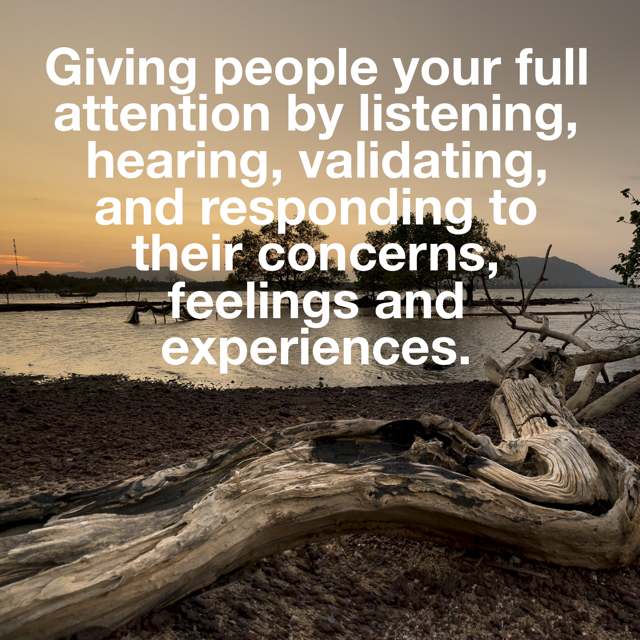
Acknowledgment: Giving people your full attention by listening, hearing, validating, and responding to their concerns, feelings and experiences. Keep in mind that it doesn't mean you necessarily agree with the person, but you see and acknowledge their suffering, which is often related to feelings of disrespect/indignity.
For future updates you can alternatively follow me Instagram:
https://www.instagram.com/jevanscounselling
Elements of Dignity-Fairness

Sometimes life truly isn't fair, but we can always strive to live with integrity. I like this quote by Johann Wolfgang von Goethe as well.
"The way you see people is the way you treat them, and the way you treat them is what they become."
For future updates you can alternatively follow me instagram:
https://www.instagram.com/jevanscounselling
Elements of Dignity-Acknowledgement
Continuing with the 10 Elements of Dignity, the experience from one human being to another of being heard, seen and valued, which can be incredibly healing, especially when one's sense of self-worth has taken a hit. Can you think of a time when you really felt acknowledged, or that you really acknowledged someone else?

Elements of Dignity-Safety
Put people at ease at two levels: physically, so they feel safe from bodily harm, and psychologically, so they feel safe from being humiliated. Help them feel free to speak without fear of retribution.

Elements of Dignity-Inclusion
Elements of Dignity-Inclusion (2 of 10) Working our way through the 10 Elements of Dignity, and involves others feeling that they belong, whatever the relationship-whether they are in your family, community, organization, or nation.

Elements of Dignity-Acceptance
I've been so inspired recently by Donna Hick's book Dignity. So much so that every few days I'm going to share an essential element of her Dignity Model, and really encourage people to leave comments or any insights/revelation. Today is the first of 10, so stay tuned!
